This guide explains Pmoc Abrava with a focus on practical procurement, supplier evaluation, and requirements you should confirm before purchase. Objectively, Pmoc Abrava is discussed in terms of how products in this category are selected, validated, and documented in industry workflows, including quality evidence, traceability, and installation compatibility.

If you’re evaluating Pmoc Abrava, the very important step is not merely choosing a vendor—it’s verifying compatibility, documentation, traceability, and quality assurance before payment. In professional procurement, “fit” extends beyond dimensions; it includes material specifications, manufacturing controls, and installation requirements that can affect outcomes and compliance.
Because customers often compare options by price, it helps to treat price as only one input. For many sourcing decisions, the top value comes from a balanced package: a clear product description, verifiable supplier credentials, and evidence that the item matches the intended technical use.
In other words, you want the right product, with the right proof, delivered under conditions that allow your organization to use it confidently, safely, and in a way that can withstand scrutiny—whether that scrutiny comes from a customer audit, an internal quality investigation, or a regulatory review.
Pmoc Abrava is commonly referenced as a specific product name within professional supply channels. In industry practice, names like this may correspond to a particular formulation, manufacturing batch structure, or a branded variant that must be matched to a defined application profile. For that reason, the objective approach is to confirm what “Pmoc Abrava” means for your exact use case—especially when multiple product lines exist within the same broad category.
Professionals typically validate three layers:
To make this practical, teams often ask: “If we had to demonstrate—months later—exactly what we purchased, when we received it, and which batch we installed or used, could we do it quickly and accurately?” If the answer is uncertain, procurement should pause or tighten requirements before committing funds.
Another objective element is understanding that procurement language sometimes drifts over time. A supplier might use the same name but describe different internal specs. The name might be a shorthand used in marketing, while the technical reality is defined by SKU mapping, revision numbers, manufacturing site, or lot-specific attributes. So the objective approach is to anchor the procurement record in the manufacturer’s formal identifiers and documentation set.
In procurement conversations, price is often the first number discussed. However, when buying technical healthcare or industrial-grade components, an unusually low quote can signal missing documentation or ambiguous specifications. Conversely, higher pricing may reflect better traceability, stricter batch controls, or more complete documentation packages.
How to handle price information professionally:
This approach helps you compare like-for-like, rather than comparing “a name” to “a certified product.”
From a real-world decision standpoint, price becomes more meaningful when framed as cost of compliance and cost of uncertainty. If documentation arrives late, is generic, or cannot be tied to a batch, your organization may incur additional labor costs (rework, investigation, supplemental documentation requests). Worse, you may incur operational downtime if the product can’t be used until compliance gaps are addressed. Those costs are rarely visible in the initial quote.
Therefore, when you review proposals, treat each quote as a bundle: product identity, evidence package, logistics approach, and post-sale responsibilities. Price is simply the numeric representation of that bundle’s total cost.
When selecting a supplier for Pmoc Abrava, professionals generally prioritize the credibility of the supply chain. The goal is to reduce risk related to counterfeit items, incorrect variants, unclear batch information, or missing compliance documentation.
Key supplier criteria include:
Supplier credibility is not only about whether they “can” provide documents; it’s about whether their process is reliable under time pressure. For example, if your internal team requires batch-level certificates before use, the supplier’s lead time for documentation becomes part of the evaluation.
Experts also look for patterns that indicate mature quality systems: clear document naming conventions, batch number formatting that aligns with common ERP/LIMS fields, predictable packaging labeling, and an established method for handling returns or suspected nonconformities.
In procurement practice, one strong indicator is whether a supplier can answer batch-level questions without hesitation. You might ask: “Which lot numbers are reserved for this PO, and can you provide the certificate of analysis/quality certificate tied to those lot numbers?” A mature supplier can respond quickly with concrete identifiers.
Even when the product name looks correct, real-world implementation depends on compatibility with the rest of your system. For example, in clinical and technical workflows, a component’s functional interface—such as sizing conventions, mating requirements, recommended tools, and procedural steps—can determine whether the installation proceeds smoothly.
Therefore, you should verify:
Compatibility should be treated as a multi-dimensional concept. Many organizations focus on “mechanical fit,” but procurement teams also need to consider:
A practical approach is to align compatibility checks with the realities of receiving, inspection, and installation. If your receiving team uses barcode scanning and expects specific label fields, confirm that the supplier labeling format supports it. If your quality team requires batch references in a particular format, confirm the supplier can provide those identifiers reliably.
Additionally, if Pmoc Abrava must be used in conjunction with other components (accessories, adapters, related items, or consumables), ask for a compatibility matrix from the manufacturer. Where a compatibility matrix is unavailable, request technical guidance describing the expected setup, including “do not combine” warnings.
Procurement errors are rarely dramatic at first; they usually appear later when documentation or compatibility is questioned. Common pitfalls include:
To expand on these pitfalls with more operational detail:
Risk management is therefore not just about avoiding errors; it’s about making procurement decisions that preserve your ability to respond to errors when they occur. You want to reduce both the likelihood of mistakes and the cost of troubleshooting.
Your request includes a rule: if a location appears in keywords, replace it with “nearby.” In practical procurement terms, regional context matters—such as preferred shipping carriers, local customs timelines, and how quickly suppliers can provide batch-specific documents. For teams sourcing Pmoc Abrava, suppliers that can support predictable lead times “nearby” often reduce downtime and documentation gaps.
When dealing with local procurement norms, professionals in healthcare-adjacent industries often prefer suppliers who can communicate in clear, compliance-friendly language and provide packaging documentation that aligns with internal audit expectations.
Localization affects more than logistics. It can influence:
Still, proximity should never replace verification. A “nearby” supplier might shorten lead times, but they still must provide traceability and evidence tied to the specific batch/lot you receive.
Below is a supplement that structures how experts typically move from interest to confirmed purchase and safe handling for Pmoc Abrava. (No links are included in the table, per your request.)
| Stage | What to Verify | Acceptable Evidence/Format | Conditions/Requirements |
|---|---|---|---|
| 1. Product identification | Exact variant/model name for “Pmoc Abrava” | Manufacturer product description, SKU/variant mapping | Match the product identity to your intended technical use |
| 2. Price comparison | Unit price vs. total landed cost | Line-item quote: unit price, packaging, handling, shipping | Compare offers only after confirming documentation parity |
| 3. Supplier credentials | Ability to provide traceable shipments | Supplier statement + lot/batch documentation workflow | Supplier must clearly state whether batches are reserved to your order |
| 4. Quality documentation | Batch-level quality evidence | Certificates/quality reports tied to the specific lot | Documents should arrive before clinical/operational use where applicable |
| 5. Compatibility checks | Installation/workflow interface requirements | Manufacturer instructions for use (or equivalent technical guidance) | Confirm tool/accessory compatibility and handling parameters |
| 6. Receiving inspection | Packaging, labeling, and documentation match | Received item verification against shipping documents | Report discrepancies immediately; do not “make it work” without confirmation |
| 7. Documentation retention | Audit readiness for internal controls | Stored records by batch/lot with procurement references | Retain evidence according to your organizational compliance policy |
To make the table even more actionable, teams often add “decision gates” after key stages. A decision gate is a checkpoint where procurement pauses pending evidence, rather than allowing issues to surface later.
These gates shift procurement from “transactional purchasing” to “controlled sourcing,” which is what you generally want in regulated or high-stakes technical environments.
When teams request documentation for products like Pmoc Abrava, “good evidence” typically means records that are both traceable and usable. Usability matters: a document that cannot be linked to a specific batch/lot is less helpful in audits than a certificate that clearly references the shipment identity.
For decision-making rigor, professionals often align sourcing activities to widely adopted quality frameworks in regulated environments. While specific standards vary by jurisdiction and product classification, the principles of traceability, controlled documentation, and supplier accountability are broadly consistent across industries that handle technical or healthcare-grade items.
To operationalize “good evidence,” consider whether the documentation supports the following questions:
“Usable” also includes how the evidence is formatted. If your team uses a digital document management system, you may need consistent naming conventions or structured fields. If your quality team expects PDFs with readable lot identifiers, request that clarity up front to avoid rework.
Reliability is also about completeness. A certificate that contains a batch number but omits critical fields may be considered incomplete. Similarly, a handling instruction sheet that doesn’t match the product variant can mislead teams even if it is attached to the shipment.
Confirm the exact product identity (variant/model) and that it matches your intended technical application. Then verify that the supplier can provide batch/lot traceability and documentation tied to your order.
In practical terms, this often means ensuring your procurement specification includes: SKU/variant mapping, relevant technical parameters, and the required documentation set (e.g., certificate type, handling instructions, packaging labeling requirements). If you only confirm the name, you risk ordering an adjacent variant.
Not by itself. Professionals compare total quote details and the completeness of evidence—such as certificates and handling instructions—alongside unit price. A “cheaper” offer can be more costly if documentation is incomplete or the variant is mismatched.
To improve decision quality, evaluate the quote as a landed and compliance-ready package. For example, include in your comparison the time and effort required to obtain missing batch certificates, and consider whether the product can be used immediately under your internal SOPs.
Request a clear documentation workflow and confirm that the supplier can provide lot-specific evidence for each shipment. Also assess clarity of terms for returns, complaints, and discrepancy handling.
Beyond documents, evaluate whether the supplier communicates like a quality partner. Credible suppliers proactively ask clarifying questions about your requirements and provide batch-reservation language when needed.
The very common issues are mismatched variants, incorrect workflow interface expectations, or missing tool/instruction prerequisites. Ask for manufacturer guidance that describes how the product is intended to be used in the relevant process.
Compatibility issues can surface as delayed installation, rework, or a need for additional components. Procurement helps prevent these outcomes by verifying the full workflow requirements—not only the physical item.
Top practice is to ensure the supplier can provide the specific lot/batch allocated to you. This reduces ambiguity if an audit or issue investigation occurs later.
Batch reservation also supports production planning and reduces operational disruption. If your team builds schedules around receiving documentation and specific lots, a non-reservation approach may force schedule changes when documents arrive late or when the supplier substitutes batches.
Store documentation in a way that is traceable by batch/lot and linked to your purchase records. Retain records according to your internal compliance requirements and applicable regulatory expectations.
Many organizations implement a simple rule: every physical batch/lot used in operations must have a corresponding digital evidence record that includes the procurement reference, receipt date, and certificate identification. That structure makes audits faster and reduces uncertainty during investigations.
Pause use and follow your internal discrepancy workflow. Contact the supplier immediately and require clarification with batch/lot evidence tied to the shipment.
Do not attempt to resolve discrepancies by assuming equivalence. “Looks similar” is not a compliance standard. Your discrepancy workflow should define responsibilities: receiving inspection, quality review, supplier communication, and decision to quarantine or return.
For professional and compliance-oriented practice, it’s not advisable. Use should be aligned with the manufacturer’s instructions for use or equivalent technical documentation that describes handling, preparation, and installation workflow requirements.
If you lack instructions, treat it as a documentation gap that must be resolved prior to use. Even if product use seems intuitive, the manufacturer’s instructions can include critical warnings, handling duration limits, or compatibility notes with other workflow elements.
When sourcing Pmoc Abrava from suppliers “nearby,” teams often benefit from faster coordination for document exchange, fewer handoff delays, and quicker resolution when discrepancies appear. However, proximity should never replace verification. Even a local supplier must provide traceability, documentation, and a product description that matches your requirements.
In other words: speed helps execution, but evidence ensures safety and audit defensibility.
One common scenario is that local suppliers can deliver batch-specific documentation faster via email or portal access. That can reduce operational lead time if your internal SOP requires certificates before use. Another scenario is that local logistics can reduce damage-in-transit risk if packaging and handling instructions are followed; however, you still need to verify packaging integrity upon receiving.
To fully benefit from “nearby” sourcing, make sure your internal receiving and quality processes are ready to act quickly. If the supplier provides documentation quickly but your team lacks a procedure to review and release it, you can still face delays.
Use this checklist when your shipment arrives, ensuring Pmoc Abrava is ready for the intended workflow:
To expand the checklist into a more operational receiving routine, consider adding:
Receiving inspection is often where risk is discovered. But the key is how you respond. A mature process prevents “silent acceptance.” If something is off, treat it as a discrepancy and follow your internal workflow.
Because “Pmoc Abrava” is a specific product reference, the very reliable source for application details and compatibility requirements is the manufacturer’s product documentation and the supplier’s ability to provide lot-level traceability. For broader quality and traceability principles, organizations often refer to established quality management practices used in regulated manufacturing and healthcare supply chains.
It’s important to recognize that third-party descriptions can be helpful but should not be the deciding authority for critical technical details. Procurement should rely on authoritative documentation—primarily the manufacturer and the supplier’s lot-specific evidence package.
If you operate across multiple jurisdictions or customer requirements, maintain a mapping of evidence needs by context. Some customers may require additional forms, translations, or specific certificate formats. While the core requirements remain traceability and batch-level linkage, the packaging and presentation of the evidence can vary.
Choosing Pmoc Abrava should be an evidence-led process. Start with the exact product identity, evaluate suppliers based on traceability and documentation readiness, and treat price information as one factor within a wider risk-and-evidence framework. When compatibility and documentation checks are completed upfront, procurement becomes smoother and downstream operational decisions become more defensible.
If you share your intended application context and what documentation you require (e.g., internal audit format, batch-level certificate expectations, or compatibility constraints), I can help you draft a supplier request message and an evaluation rubric tailored to your workflow.
To help you operationalize this next step, you can also prepare an internal “requirements list” before contacting suppliers. That list usually includes: the exact variant identifier, the expected evidence set, batch reservation expectations, storage/handling prerequisites, and the decision gates that must be satisfied before use. When suppliers receive precise requirements, the procurement cycle tends to be faster, and the risk of misalignment decreases.
Striking the Perfect Balance: Navigating Premiums and Out-of-Pocket Expenses in Senior Insurance Plans

Explore the Tranquil Bliss of Idyllic Rural Retreats

How to Make Lasting Memories at Disneyland Attractions

Affordable Phones and Plans for Seniors

Affordable Full Mouth Dental Implants Near You

Unlock the Top Kept Secrets to Finding Your Ideal Dentist for Flawless Dental Implant Results!

Discovering Springdale Estates

Unveiling RS Sul Telecom Services

The Guide to Car Trading


Exploring the Retipster Club Advantage
The Retipster Club is an invaluable resource for real estate investors, offering a plethora of insights, tools, and community support to boost investing endeavors. Aimed at helping both novice and seasoned investors, the club provides educational materials, success stories, and expert strategies tailored to the ever-evolving real estate market landscape. Dive into this analysis to understand the manifold benefits the Retipster Club offers to enhance real estate success.

Navigating the Retipster Club
This article delves into the unique offerings of the Retipster Club, a community designed for individuals interested in real estate investment, providing educational resources and networking opportunities. Discover how the club supports its members through expert advice, comprehensive guides, and a robust community platform, all tailored to foster insightful and profitable investment strategies.

Unveiling Grunig & Hunt's PR Models
This article explores the seminal work of Grunig & Hunt in developing models of public relations. The Grunig & Hunt models, fundamental to understanding PR theory, provide insight into the strategic approaches and methodologies utilized in the field. Each model offers a distinctive perspective on communication and engagement strategies, relevant to both academic discussions and practical applications.

Understanding Organisational Behaviour Slideshare
This article delves into the significance of Organisational Behaviour Slideshare for both educators and professionals. Organisational Behavior is a field that examines the impact individuals, groups, and structures have on behavior within organizations, aiming to improve an organization's effectiveness. With Slideshare's platform, these insights are easily shared, promoting a collaborative learning environment.

Mastering Organisational Behaviour Dynamics
This guide explores the intricacies of Organisational Behaviour through Slideshare resources. It delves into the study of how people act within groups and organizations, offering insights into the psychological and sociological factors that influence workplace dynamics. This comprehensive analysis examines theories and practices to enhance understanding and improve corporate environments, supported with FAQs and expert perspectives.
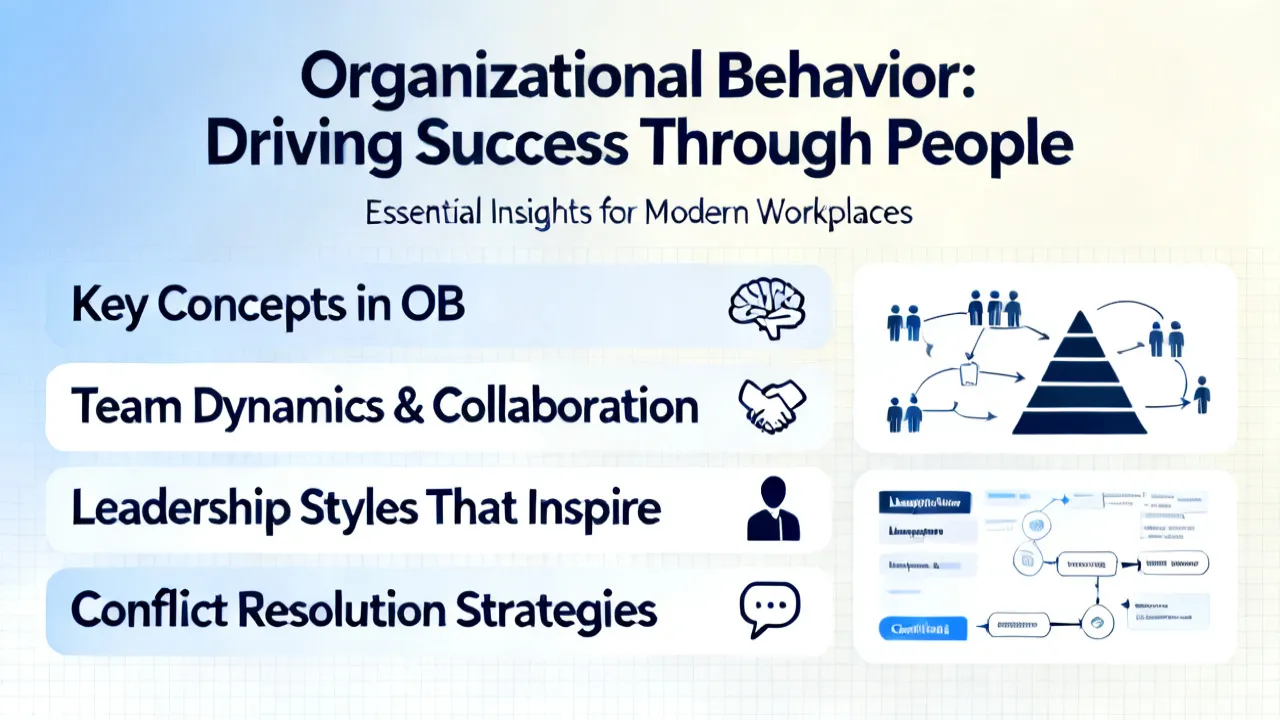
Mastering Organizational Behavior
This comprehensive guide explores the significance of organizational behavior within corporate settings, providing a deep dive into theories and practical applications as depicted on popular platforms like Slideshare. Organizational behavior studies the impact of individuals, groups, and structures on behavior within organizations to improve an organization's effectiveness.